for enquiring minds
Enquiries to: info@glossopguild.org
PRemember, to book a place, you may either:
(1) pay on line by clicking on the 'booking' link above or
(2) download the booking form from the home page.
Autumn 2015
 The
Rise and Rise of Venice/Birgitta Hoffman
The
Rise and Rise of Venice/Birgitta Hoffman5 Wednesdays: 30 September; 7,14,21,28 October
Bradbury Community House, Market Street, Glossop
11.00~13.00h; Fee £30 (Members £27.50)
Venice is a very special place – not just for a visit, but also because it appears to be the one place in Europe, which is always the exception. Built in a swamp, it became the richest town in Europe – and all that without a hinterland. When Europe forgot about long-distance trade, it brought the wealth of the Orient to it. And when the Ottoman Empire set out to conquer the world, it decided to fight it, frequently on its own only to side with it for economic reasons. Catholic to the core, it supported protestant states all over Europe. The longest lived “democratic system” in Europe, it was also the most restrictive in access to power. And even shorn of much of its political power, it became the powerhouse of art and Western culture for three centuries. This course is a tour through the history and Culture of Venice from its beginnings to the surrender to Napoleon.
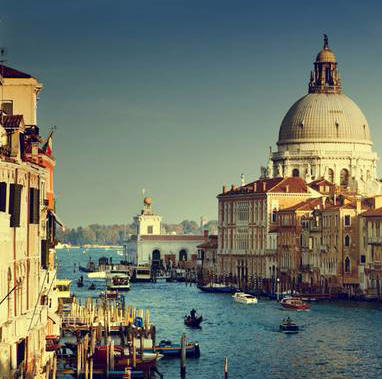
Grand Canal ~ Venice
 Northern Powerhouse or Northern
Poorhouse?/Mick Moran
Northern Powerhouse or Northern
Poorhouse?/Mick Moran5 Wednesdays: 30 September; 7,14,21,28 October
Bradbury Community House, Market Street, Glossop
19.30~21.30h; Fee £30 (Members £27.50)
The course examines the latest big idea: devolution of power and responsibility from the central state in Whitehall to the regions, with Manchester and the north west identified as the ‘Northern Powerhouse.’ What is the reality behind this idea? Does it justify the designation ‘powerhouse’? If so, how can it be reconciled with a fifty year history of economic decline, and a recent history of centrally imposed cuts on regional budgets? The course takes no partisan position on these questions. In five sessions, it examines the political and economic background to the ‘Powerhouse’ proposals and examines the origin of those proposals – who is winning and who losing from them? It describes the content of what is presently on offer and analyses what might be on offer in the future. The sessions will be a mix of hard information and open discussion, allowing all those attending to arrive at their own (informed) view.
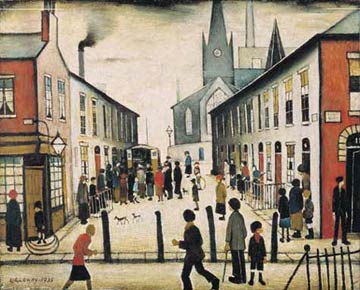
Northern street scene ~ L.S. Lowry
 The French musical Impressionists/
Gordon Gange
The French musical Impressionists/
Gordon Gange5 Wednesdays: 4,11,18,25 November; 2 December
Bradbury Community House, Market Street, Glossop
19.30~21.30h; Fee £30 (Members £27.50)
Perhaps no other genre of classical music has such close connections with the worlds of art and literature, as does French Impressionism. We shall hear how Debussy and Ravel reproduce in music the dreamy world of Mallarme the poet, the misty auras of the early Impressionist painters, or the scintillating colours of Monet or the Pointillists. We shall look at orchestral depictions such as Debussy’s La Mer; Ravel’s pianistic depiction of fountains, in Jeux d’Eau, which he contended to be the first Impressionist composition: and both composers’ fusion of classical music, dance and jazz. We shall hear how Ravel's delicate porcelain orchestration and both composers' love of Japanese and oriental art influenced countless younger composers.
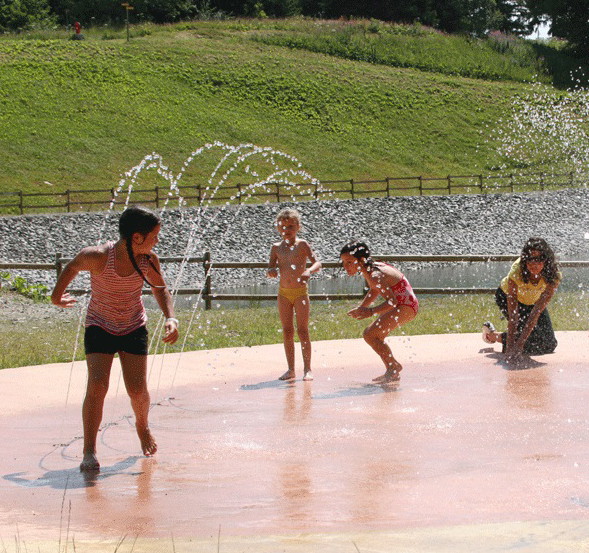
Jeux d'Eau ~ water games
 19th
Century Leisure and Sport/David Day, Keith
Myerscough, Craig Horner, Gary James,
Claire Robinson, Rachel Johnson
19th
Century Leisure and Sport/David Day, Keith
Myerscough, Craig Horner, Gary James,
Claire Robinson, Rachel Johnson& Samantha Oldfield
5 Thursdays: 5, 12, 19, 26 November; 3 December
Bradbury Community House, Market Street, Glossop
19.30~21.30h; Fee £30 (Members £27.50)
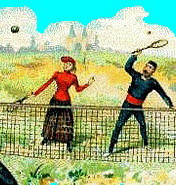
This five-week course looks at aspects of sport and leisure in the North-West of England during the nineteenth and early twentieth centuries with a particular focus on Lancashire and the city of Manchester. The programme draws together all aspects of leisure, from music and theatre to motoring and sport, and highlights the rich diversity of leisure interests that characterised the Victorian and Edwardian periods. The connections between sport and entertainment clearly emerge during the course of the talks and this reinforces the importance of these activities to individuals and communities in an age before radio and television.
Victorian ball games
 Decline and Fall of the Roman Empire/Chris
Binns
Decline and Fall of the Roman Empire/Chris
Binns5 Fridays: 6,13,20,27 November; 4 December
Bradbury Community House, Market Street, Glossop
10.30~12.30h; Fee £30 (Members £27.50)
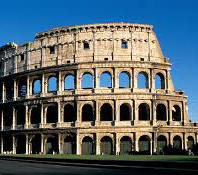
Ever since his early training as a classicist, Chris has had a fascination for the problem of the decline and fall of the Roman Empire, enhanced by reading Gibbon. But modern scholarship has moved on a lot from Gibbon in its analysis of the functioning of the empire in its heyday (the 2nd Century AD), the problems of the later empire, its alleged collapse and the character of the ‘barbarian’ kingdoms which succeeded it. Chris will be reviewing these questions in this course, in an effort to convey the excitement of this momentous period of European ‘late antiquity’.
Roman Colosseum
 Graham
Greene, Phuong and me/Creina Mansfield
Graham
Greene, Phuong and me/Creina MansfieldDay-school: Saturday 10 October
Glossop Labour Club, Chapel Street, Glossop
10.00~16.00; Fee £25 (Members £20)
Graham Greene was one of the twentieth century’s foremost writers. His characterization of Phuong in The Quiet American has been criticized as stereotyped. Is this fair? We will look at his life & works, with particular reference to female characters. Creina will explain how she was inspired (or provoked) into writing Phuong’s story. Orientalism, the Vietnam War and feminist revisionist literature will be the topics of the day. Creina will read from The Quiet Soldier: Phuong’s Story, published last autumn.
Phuong ~ in The Quiet American (2002)
 Enjoying and uderstanding Opera/Glyn
Davies
Enjoying and uderstanding Opera/Glyn
DaviesDay-School: Saturday 7 November
Partington Theatre, Henry Street, Glossop
10.00~16.00; Fee £30 (Members £25)
This Day-School will is aimed at the person who has made one or two steps into the opera world and would like to learn more. It will examine trends in opera over the past four centuries, with the aid of anecdotes about the artists and extracts from performances. We will also talk about the different opportunities available to experience this rich art form. The day will be illustrated by DVDs, CDs and on the keyboard.
Don Giovanni ~ record sleeve
 Night
and the City/Creina Mansfield and Alan Sennett
Night
and the City/Creina Mansfield and Alan SennettFilm-day: Saturday 21 November
Partington Theatre, Henry Street, Glossop
10.00~16.00; Fee £30 (Members £25)
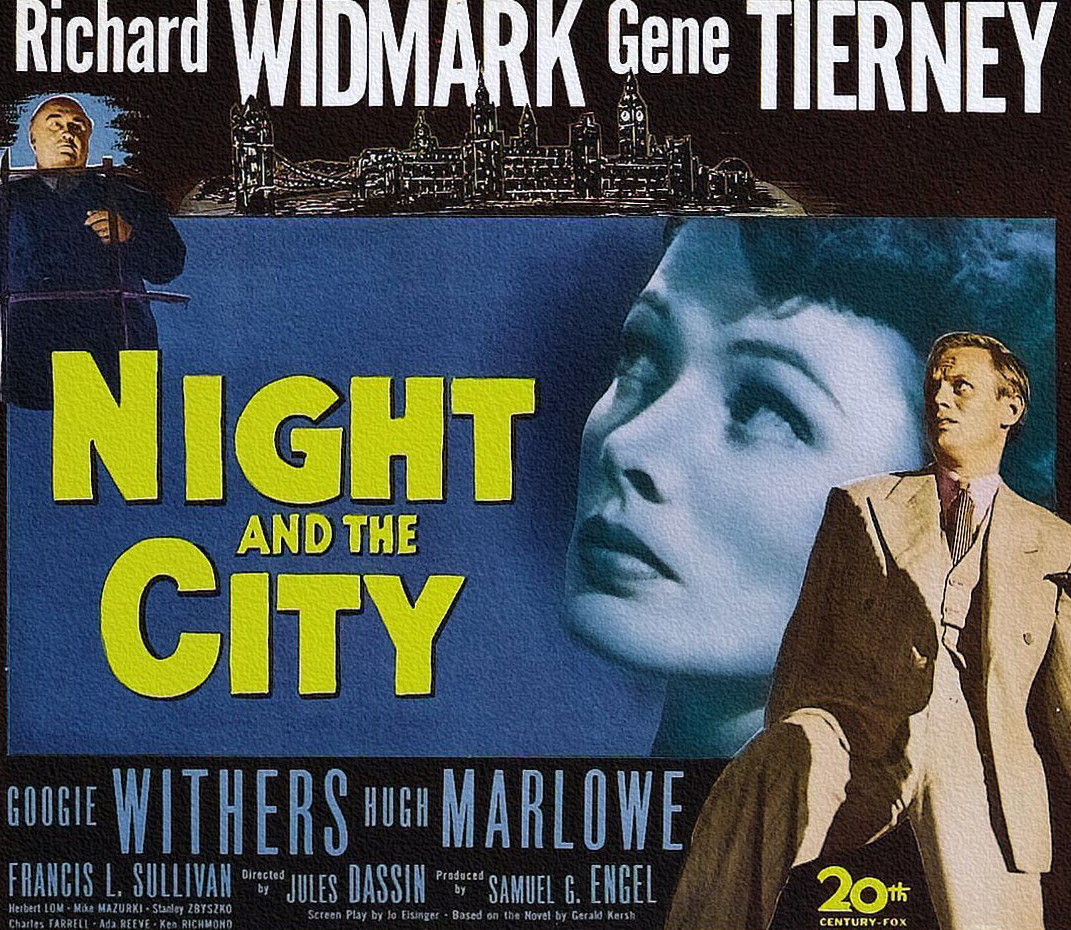
Night and the City (1950) is a classic film noir. Directed by Jules Dassin, it was filmed in postwar London, after Dassin as an ex-communist had been put on McCarthy’s Hollywood Blacklist. The film is based on Gerald Kersh’s remarkable novel Night and the City (1938), although Dassin later maintained that he had never read the novel himself. The story concerns the seedy nightlife of 1930s London. Its central character, Harry Fabian, is played by Richard Widmark. A small-time crook takes advantage of some fortuitous circumstances to try to become a big-time player as a wrestling promoter. This day-school will view the 1950 film in sections and compare it with Gerald Kersh’s novel. The film was remade in 1992 but the action was transposed to New York.
.
Night and the City (1950)
Spring 2016
 The Bloomsbury Set/Creina
Mansfield
The Bloomsbury Set/Creina
Mansfield5 Mondays: 15, 22, 29 February; 7, 14 March
Bradbury Community House, Market Street, Glossop
14.00~16.00h; Fee £30.00 (Members £27.50)
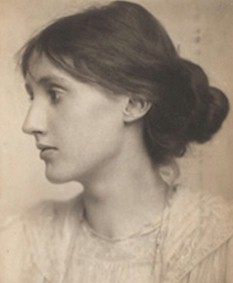
In this course, we shall look at the literature that came from the group of free-thinking and gifted intellectuals ‘who lived in squares but loved in triangles’. Who were they and did they share a collective philosophy? We shall study two works by leading members of the Bloomsbury group: the first Eminent Victorians by Lytton Strachey and the second Mrs Dalloway by Virginia Woolf.
Virginia Woolf
 World Empires (1800~1945)/Alan
Sennett
World Empires (1800~1945)/Alan
Sennett10 Tuesdays: 12,19, 26 January; 2,9,16,23 Feb; 1,8,15 Mar
Glossop Labour Club, Chapel Street, Glossop
19.30~21.30h; Fee £60 (Members £55)
This course examines in depth the colonial expansions and interactions of the highest stage of imperial expansion. Through a series of case studies, it looks at military power (Britain and France), economic power (Britain), the Ottoman Empire, settler imperialism (New Zealand and Algeria), nationalism and empire in Africa, China and Austria Hungary, We will also consider themes such as culture, gender and sex, as well as a case study in land and environment (Kenya).
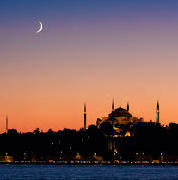
Istanbul at night
 Gondwana ~
revelations of a supercontinent/Robert Callow
Gondwana ~
revelations of a supercontinent/Robert Callow10 Wednesdays: 13, 20, 27 Jan; 3, 10, 17, 24 Feb; 2, 9, 16 Mar
Bradbury Community House, Market Street, Glossop
19.30~21.30h; Fee £60 (Members £55)
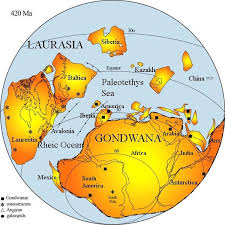
The supercontinent of Gondwana, formed some 200 million years ago, crept into human consciousness, through a series of startling revelations. The distributions of major groups of animals and plants, both fossil and living, show links across continents now widely separated. The coastlines of southern continents were shown to fit together like pieces of a jig-saw puzzle, leading to the theory of continental drift. Global patterns of physical geography, earthquakes and ancient magnetism in the rocks, pointed to the existence and motion of massive tectonic plates. Presentations will be supported with visual images. Detailed notes will be provided and discussion encouraged.
Gondwana
 The transition from religious to
non-religious art/Ian Stubbs
The transition from religious to
non-religious art/Ian Stubbs5 Thursdays: 14, 21, 28 January; 4, 11 February
Bradbury Community House, Market Street, Glossop
19.30~21.30h; Fee £30 (Members £27.50)
Nietzsche's declaration in1882 that ‘God is dead’ conveyed the view that, through critical thinking and modern discoveries in science and technology, the Christian religion is now displaced as the primary way in which people in Western culture interpret and understand the universe, human life and its purposes. In Robert Hughes’s seminal book The Shock of the New, covering the period 1874-1991, of 268 illustrations only 9 can be considered religious. This course will explore the story of that seismic shift through the responses to it, as expressed in the work and vision of some of the key artists and movements of Modern and Post-modern Art.
This course has had to be cancelled, as the tutor is indisposed.
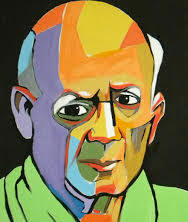
Picasso ~ self portrait
 Four local rivers ~ landscapes and
communities/David Frith
Four local rivers ~ landscapes and
communities/David Frith5 Thursdays: 18,25 February; 3,10,17 March
Bradbury Community House, Market Street, Glossop
19.30~21.30h; Fee £30 (Members £27.50)
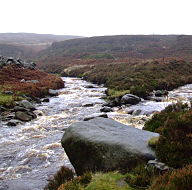
In this course, the well known walker and footpaths champion David Frith will follow the courses of Glossop Brook through to the Etherow and finally into the Goyt. Along the way, we shall explore landscape and local history. Black and white photographs will illustrate times gone by. Following Glossop Brook, we shall explore Old Glossop, Howard Town and Dinting. Along the Etherow, we shall penetrate the Longendale valley and the villages of Mottram, Hollingworth and Crowden. Following the Goyt from its source above the Cat and Fiddle to Stockport, we shall take a look at Whalley Bridge. The course of the Noe from its source on Kinder Scout will allow us to explore the Hope Valley, Mam Tor and the villages of Castleton and Edale.
Sadly, David died this November.
Our thoughts and condolences go out to his family.
River Etherow
 Franz Schubert ~ master of lyric and
lieder/Gordon Gange
Franz Schubert ~ master of lyric and
lieder/Gordon GangeDay-school: Saturday 12 March (changed from the date in the brochure)
Partington Theatre, Henry Street, Glossop
10.00~16.00h; Fee £30 (Members £25)
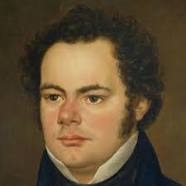
During Franz Schubert’s short, obscure life he established his name as synonymous with song. We shall hear how he wove voice, piano and poetry to create some of the world’s most wonderful songs, forging a new and lasting art form, and how song fertilised his most glorious chamber music. As usual the day will finish with a live performance.
Franz Schubert
 Remains
of the Day/Creina Mansfield & Alan Sennett
Remains
of the Day/Creina Mansfield & Alan SennettFilm-day: Saturday 5 March
Partington Theatre, Henry Street, Glossop
10.00~16.00h; Fee £30 (Members £25)
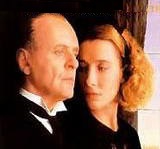
In 1956, Stevens (played by Anthony Hopkins) a long-serving butler at Darlington Hall, takes a motoring trip through the West Country. The journey becomes one into his own past as he asks himself whether his sense of duty has led him to waste his life. He gave up romance in order to serve an aristocrat and politician who favoured rapprochement with Germany during the 1930’s. Is it now too late? This day school will view the 1993 film in sections and consider the historical background to the events portrayed. We will compare it with Kazuo Ishiguro’s novel on which it is based. Directed by James Ivory, the film is a meditation on duty, on love and the condition of England at a time of acute change.
Remains of the Day (1993)